
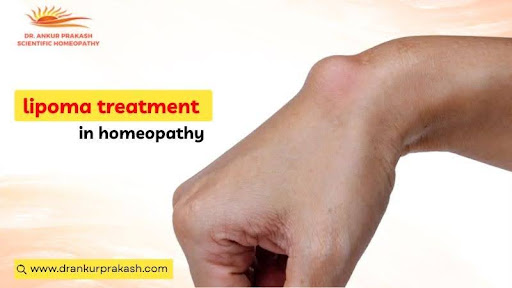
Lipomas are soft, non-cancerous fatty lumps that develop beneath the skin. They are usually harmless, painless, and slow-growing, but many people seek treatment due to cosmetic concerns, discomfort, or multiple recurring lumps.
Homeopathy is considered by some patients as a complementary and non-surgical approach focused on overall wellness and individualized care. However, scientific evidence supporting homeopathy for reducing or eliminating lipomas remains limited, and surgical removal continues to be the medically proven treatment for permanent removal.
What is a Lipoma?
A lipoma is a benign growth made up of fat cells that develops under the skin. These lumps are generally soft, movable, and painless when touched. Lipomas commonly appear on the neck, shoulders, back, arms, abdomen, or thighs.
Lipomas usually grow slowly over time and rarely become dangerous. However, larger lipomas may cause discomfort, pressure on nearby tissues, or cosmetic concerns depending on their location.
According to medical sources such as the NHS and MedlinePlus, lipomas affect approximately 1–2% of the population, making them one of the most common soft tissue tumors.
What Causes Lipoma in the Body?
The exact cause of lipoma is not fully understood, but several factors may contribute to its development.
Genetic Predisposition
Genetics is considered one of the major contributing factors. Individuals with a family history of lipomas may have a higher chance of developing them. Certain inherited conditions, such as familial multiple lipomatosis, can lead to multiple lipomas across the body.
Abnormal Fat Metabolism
Irregular fat processing and storage in the body may contribute to localized fat accumulation beneath the skin.
Hormonal Imbalance
Hormonal changes related to aging, menopause, thyroid imbalance, or metabolic changes may influence fat distribution and tissue growth.
Obesity and Sedentary Lifestyle
Although lipomas can occur in anyone, lack of physical activity and excess body fat may increase risk factors associated with abnormal fat accumulation.
Minor Injuries or Trauma
Some individuals report lipoma development near areas of previous injury. While trauma is not considered a direct cause, it may act as a trigger in susceptible individuals.
Metabolic Disorders
Certain metabolic conditions may be associated with uneven fat distribution and soft tissue growth.
Homeopathy Perspective
Homeopathy is considered by some individuals as a complementary wellness-based approach focused on individualized remedies and overall body balance. However, there is limited scientific evidence proving that homeopathy can shrink or eliminate lipomas.
What Are the Common Symptoms of Lipoma?
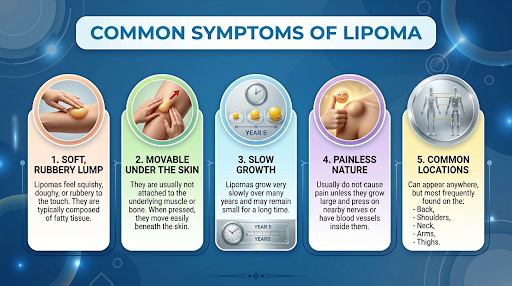
In most cases, lipomas do not cause serious symptoms apart from the presence of a soft lump beneath the skin. They usually grow slowly and remain harmless for years. However, depending on the size and location, some lipomas may lead to discomfort or cosmetic concerns.
Soft, Movable Lump
Lipomas are commonly identified as soft, rubbery lumps beneath the skin. They usually move slightly when touched and can feel doughy or smooth in texture. This soft and movable nature is one of the main characteristics that differentiates lipomas from other types of skin growths.
Slow Growth
One of the most noticeable features of a lipoma is its gradual growth. Lipomas often begin as small, barely visible lumps and slowly increase in size over months or years. Some remain small permanently, while others may grow larger over time.
Common Locations
Lipomas can develop anywhere in the body where fat cells are present. The most common locations include:
- Neck
- Shoulders
- Back
- Arms
- Abdomen
- Thighs
In less common cases, lipomas may also appear on the scalp, hands, feet, or deeper inside the body.
Discomfort or Mild Pain
Most lipomas are painless. However, larger lipomas or those located near nerves, muscles, or joints may cause mild discomfort, soreness, or pressure. Deep lipomas may sometimes interfere with movement depending on their location.
Changes in Appearance
As lipomas grow, they may become more visible beneath the skin and create noticeable swelling or unevenness in the affected area. Lipomas on visible body parts such as the neck, arms, or forehead may cause cosmetic concerns for some individuals.
Restricted Movement
In rare cases, lipomas located near joints or deep within muscle tissue may limit movement or create stiffness in the surrounding area.
When to See a Doctor
Although lipomas are generally harmless, medical evaluation is important if:
- The lump grows rapidly
- The area becomes painful
- The lump feels hard or fixed in place
- Skin color changes occur
- Movement becomes restricted
These symptoms may require further examination to rule out other conditions.
What Are the Different Types of Lipoma?
Lipomas can vary depending on their location, structure, and the tissues involved. While most lipomas are harmless and slow-growing, some types may develop deeper inside the body or cause discomfort due to their size or location.
1) Conventional Lipoma:
This is the most common type of lipoma, known for its soft and movable texture beneath the skin. Conventional lipomas are usually painless and grow slowly over time. They are considered benign and are commonly found on the arms, thighs, abdomen, neck, and back.
2) Superficial Subcutaneous Lipoma:
These lipomas develop just beneath the skin surface and are among the easiest to identify. They often appear as small, smooth, and soft lumps that can move slightly when touched. Superficial subcutaneous lipomas commonly occur on the shoulders, neck, upper back, and arms.
3) Deep Lipoma:
Deep lipomas develop inside the body, usually within muscles or around internal tissues. Because they grow in deeper areas, they may become larger before being noticed. Unlike superficial lipomas, deep lipomas can sometimes cause discomfort, pressure, or restricted movement depending on their location.
4) Angiolipoma:
Angiolipomas contain both fatty tissue and blood vessels. Unlike regular lipomas, they may be painful or tender when touched. These lipomas are more commonly seen in young adults and often develop on the forearms, upper arms, or chest.
5) Fibrolipoma:
Fibrolipomas are made up of fatty tissue mixed with fibrous connective tissue, which gives them a slightly firmer feel compared to regular lipomas. They usually grow slowly and may appear on the neck, back, or shoulder region.
6) Intramuscular Lipoma:
This type of lipoma grows deeper within muscle tissue rather than beneath the skin. Intramuscular lipomas are less common and may sometimes cause muscle discomfort, swelling, or difficulty in movement if they become large.
7) Spindle Cell Lipoma:
Spindle cell lipoma is a rare benign variant that is most commonly found in middle-aged men. These lipomas generally appear on the neck, upper back, or shoulders and usually grow slowly without causing pain.
8) Pleomorphic Lipoma:
Pleomorphic lipoma is an uncommon type that may appear unusual under microscopic examination but is generally non-cancerous. It most commonly occurs in older adults and is usually found around the neck or upper back area.
Why Proper Diagnosis Is Important
Although most lipomas are harmless, some rare soft tissue tumors may resemble lipomas. Any lump that grows rapidly, becomes painful, feels hard, or changes in shape should be evaluated by a qualified medical professional for accurate diagnosis and treatment guidance.
What Are the Risk Factors for Lipoma?
Several factors may increase the likelihood of developing lipomas.
Age (40–60 Years): Lipomas are more commonly diagnosed in middle-aged adults.
Example: A 45-year-old office worker notices a slow-growing lump on the shoulder.
Family History: People with close relatives who have lipomas may have a higher genetic risk.
Obesity and Inactive Lifestyle: Poor metabolism and excess body fat may contribute to abnormal fat deposits.
Hormonal Changes: Hormonal fluctuations during aging or menopause may influence fat growth and distribution.
Metabolic Disorders: Certain metabolic conditions may increase the chances of soft tissue growth.
Some studies suggest an association between metabolic disorders and lipoma formation, although the exact relationship remains unclear.

Can Lipoma Cause Complications?
Most lipomas are harmless, but some cases may lead to complications depending on their size or location.
Pain or Discomfort: Large lipomas may press against nearby nerves or muscles.
Restricted Movement: Lipomas near joints may interfere with normal movement.
Cosmetic Concerns: Visible lipomas on the neck, face, or arms may affect confidence and appearance.
Compression of Nearby Structures: Rare deep lipomas may affect surrounding tissues or nerves.
Any rapidly growing, painful, or hard lump should be evaluated immediately to rule out serious conditions such as liposarcoma.
How is Lipoma Diagnosed?
Diagnosis is usually straightforward and may include the following steps.
Physical Examination
Doctors examine the lump for texture, mobility, size, and tenderness.
Medical History
Questions about growth, pain, or family history help guide diagnosis.
Imaging Tests
Imaging may be recommended in some cases:
- Ultrasound
- MRI
- CT scan for deeper lipomas
Biopsy
A biopsy may be performed if doctors suspect an unusual or potentially cancerous growth.
What Are the Treatment Options for Lipoma?
The treatment for lipoma depends on several factors, including the size of the lump, its location, symptoms, cosmetic concerns, and whether it interferes with daily activities. Since most lipomas are benign and painless, not every case requires immediate treatment. Doctors usually recommend treatment only when the lipoma becomes painful, grows rapidly, restricts movement, or affects appearance.
1) Observation and Monitoring
Small and painless lipomas often do not require active treatment. In many cases, doctors simply recommend monitoring the lump over time to check for changes in size, texture, or symptoms.
This approach is generally suitable when:
- The lipoma is small and harmless
- There is no pain or discomfort
- Movement is not affected
- Cosmetic concerns are minimal
Regular medical checkups are important to ensure the lump does not develop unusual changes.
2) Surgical Removal
Surgical excision is considered the gold standard treatment for lipomas because it completely removes the fatty lump along with its capsule. It is commonly recommended for large, painful, rapidly growing, or cosmetically concerning lipomas.
Advantages of Surgery:
- Permanent removal in most cases
- Lower recurrence risk compared to non-surgical methods
- Immediate reduction of swelling or discomfort
Limitations:
- Minor scarring may occur
- Recovery time depends on the size and location
- Large or deep lipomas may require a more complex procedure
3) Liposuction
Liposuction is a minimally invasive procedure used to remove fatty tissue through suction techniques. It may be considered for soft and larger lipomas where reducing visible scarring is a priority.
Benefits:
- Smaller scars compared to surgery
- Faster recovery in some cases
- Less invasive procedure
Limitations:
- The entire capsule may not be removed
- Slightly higher chance of recurrence
4) Steroid Injections
Steroid injections are sometimes used to temporarily reduce the size of smaller lipomas. These injections may shrink the fatty tissue but usually do not remove the lipoma completely.
Benefits:
- Non-surgical option
- Simple outpatient procedure
Limitations:
- Results are usually temporary
- Multiple sessions may be required
- Lipoma may continue growing later
5) Homeopathic Supportive Care
Some individuals choose homeopathy as a complementary wellness-focused approach for managing lipomas. Homeopathic treatment is generally based on individualized remedies, lifestyle guidance, and overall metabolic support.
Supportive goals may include:
- Promoting overall wellness
- Supporting metabolic balance
- Providing individualized care based on symptoms
- Addressing associated lifestyle factors
However, patients should understand the following:
- Scientific evidence supporting homeopathy for lipoma reduction remains limited
- Results can vary significantly from person to person
- Homeopathy should not replace proper medical diagnosis or surgical evaluation
- Surgery remains the only medically proven permanent treatment for lipoma removal
Common Homeopathic Remedies Used for Lipoma Support
In homeopathy, remedies are selected based on an individual’s overall health condition, symptoms, body type, and medical history. Different remedies may be considered for different patterns of lipoma development. However, it is important to understand that scientific evidence supporting homeopathy for lipoma reduction remains limited, and remedies should only be taken under professional guidance.
1) Calcarea Carbonica
Calcarea Carbonica is commonly discussed in homeopathy for individuals who tend to gain weight easily, experience slow metabolism, excessive sweating, or frequent fatigue. It may be considered in cases where fatty tissue accumulation is associated with sluggish body functioning.
2) Thuja Occidentalis
Thuja Occidentalis is traditionally associated with skin-related growths and soft tissue swellings in homeopathic practice. Some practitioners consider it for individuals with multiple fatty lumps or recurring skin and tissue growth tendencies.
3) Bellis Perennis
Bellis Perennis is sometimes considered for deep tissue concerns, especially when fatty lumps develop after minor injuries or physical trauma. It is also discussed in homeopathy for muscle and connective tissue support.
4) Baryta Carbonica
Baryta Carbonica may be recommended in certain cases involving slow-growing fatty lumps in older individuals. Homeopathic practitioners sometimes associate this remedy with glandular swelling and age-related tissue changes.
5) Graphites
Graphites is often discussed in homeopathy for people with obesity tendencies, dry skin problems, sluggish metabolism, or recurring skin-related concerns along with fatty tissue accumulation.
Important Medical Note
The remedies mentioned above are commonly referenced in homeopathic practice, but there is limited scientific evidence proving their effectiveness in shrinking or eliminating lipomas.
Homeopathic remedies should not replace proper medical diagnosis, imaging tests, or surgical evaluation when necessary. Self-medication is not advised, and treatment decisions should always be made under the supervision of a qualified healthcare professional.
Evidence Summary
Evidence Summary
Different treatment approaches for lipoma have varying levels of medical evidence, effectiveness, and long-term outcomes. The table below provides a simple comparison to help patients understand the commonly used treatment options.
| Treatment Option | Purpose | Benefits | Limitations | Evidence Level |
|---|---|---|---|---|
| Observation and Monitoring | To monitor small, painless lipomas without immediate treatment | No surgery or recovery required | Lipoma may continue growing over time | Standard medical approach for harmless lipomas |
| Surgical Removal | Complete removal of the lipoma and its capsule | Permanent removal in most cases with low recurrence risk | Minor scarring and recovery time may occur | Strong scientific evidence; considered the gold standard treatment |
| Liposuction | Removal of fatty tissue using suction techniques | Smaller scars and minimally invasive procedure | Entire capsule may not be removed, increasing recurrence risk | Moderate clinical evidence for selected cases |
| Steroid Injections | Temporary reduction in lipoma size | Non-surgical and quick outpatient procedure | Results are temporary and multiple sessions may be needed | Limited medical evidence |
| Homeopathic Supportive Care | Complementary wellness-focused management approach | Individualized care and lifestyle guidance | Limited scientific evidence; results vary between individuals | Mainly anecdotal and low-quality scientific evidence |
When Homeopathy May Not Be Suitable
Immediate surgical or specialist evaluation is recommended if:
- Lipoma grows rapidly
- Lump becomes painful or hard
- Size exceeds 5 cm
- Movement becomes restricted
- There is suspicion of liposarcoma or another tumor
Delaying proper medical evaluation in these situations may increase health risks.
Can Lipoma Be Prevented?
There is no guaranteed way to prevent lipomas because genetics often plays a major role. However, maintaining overall metabolic and physical health may help support healthy fat distribution and reduce certain risk factors.
Prevention and Wellness Tips
- Maintain a healthy body weight
- Follow a balanced diet rich in whole foods
- Exercise regularly to support metabolism
- Avoid excessive processed and high-fat foods
- Manage hormonal and metabolic disorders properly
- Schedule regular medical checkups if you have a family history of lipomas
While these measures may support overall health, they cannot completely prevent lipoma formation.
About Dr. Ankur Prakash
Dr. Ankur Prakash is a homeopathic doctor based in Agra, India, known for his patient-focused and holistic treatment approach.
His consultation process focuses on:
- Detailed case analysis
- Personalized wellness guidance
- Long-term health management
- Non-invasive supportive care
Patients are advised to verify qualifications, clinic registration, and treatment suitability directly through official consultation channels.
Frequently Asked Questions
Can homeopathy remove lipoma permanently?
Scientific evidence supporting permanent lipoma removal through homeopathy is limited. Surgical removal remains the medically proven treatment for permanently eliminating lipomas.
Is lipoma dangerous?
Most lipomas are harmless and non-cancerous. However, any lump that grows rapidly, becomes painful, or changes in texture should be medically evaluated.
Can lipoma turn into cancer?
Lipomas themselves are benign and usually do not become cancerous. However, rare cancerous tumors called liposarcomas may resemble lipomas, which is why proper diagnosis is important.
Is surgery necessary for every lipoma?
No. Small and painless lipomas often do not require treatment. Surgery is usually recommended when the lipoma causes pain, cosmetic concerns, or movement restriction.
What is the best treatment for lipoma?
Surgical removal is considered the gold standard treatment because it completely removes the fatty lump. Other approaches, including observation and complementary therapies, may be considered based on individual preference and medical advice.
How much does lipoma surgery cost in India?
Lipoma surgery in India may cost approximately ₹15,000 to ₹50,000 depending on the size, location, hospital, and surgeon.
Can diet reduce lipoma size?
There is no scientific evidence that diet alone can shrink lipomas. However, maintaining a healthy lifestyle may support overall metabolic health.
Key Takeaways
- Lipomas are common benign fatty lumps
- Most lipomas are harmless and painless
- Surgical removal is the medically proven treatment for permanent removal
- Homeopathy may be used by some patients as a complementary wellness approach
- Scientific evidence for homeopathy in lipoma reduction remains limited
- Any rapidly growing or painful lump requires immediate medical evaluation
Disclaimer
This article is intended for educational and informational purposes only and should not be considered medical advice.
Homeopathic remedies are not evaluated by the FDA for treating lipomas, and scientific evidence supporting homeopathy for lipoma reduction remains limited. Individual results may vary significantly.
Always consult a qualified healthcare professional before starting any treatment. Surgical removal remains the standard medically proven treatment for permanent lipoma removal.